
Yin Yoga Is So Much More Than I Thought
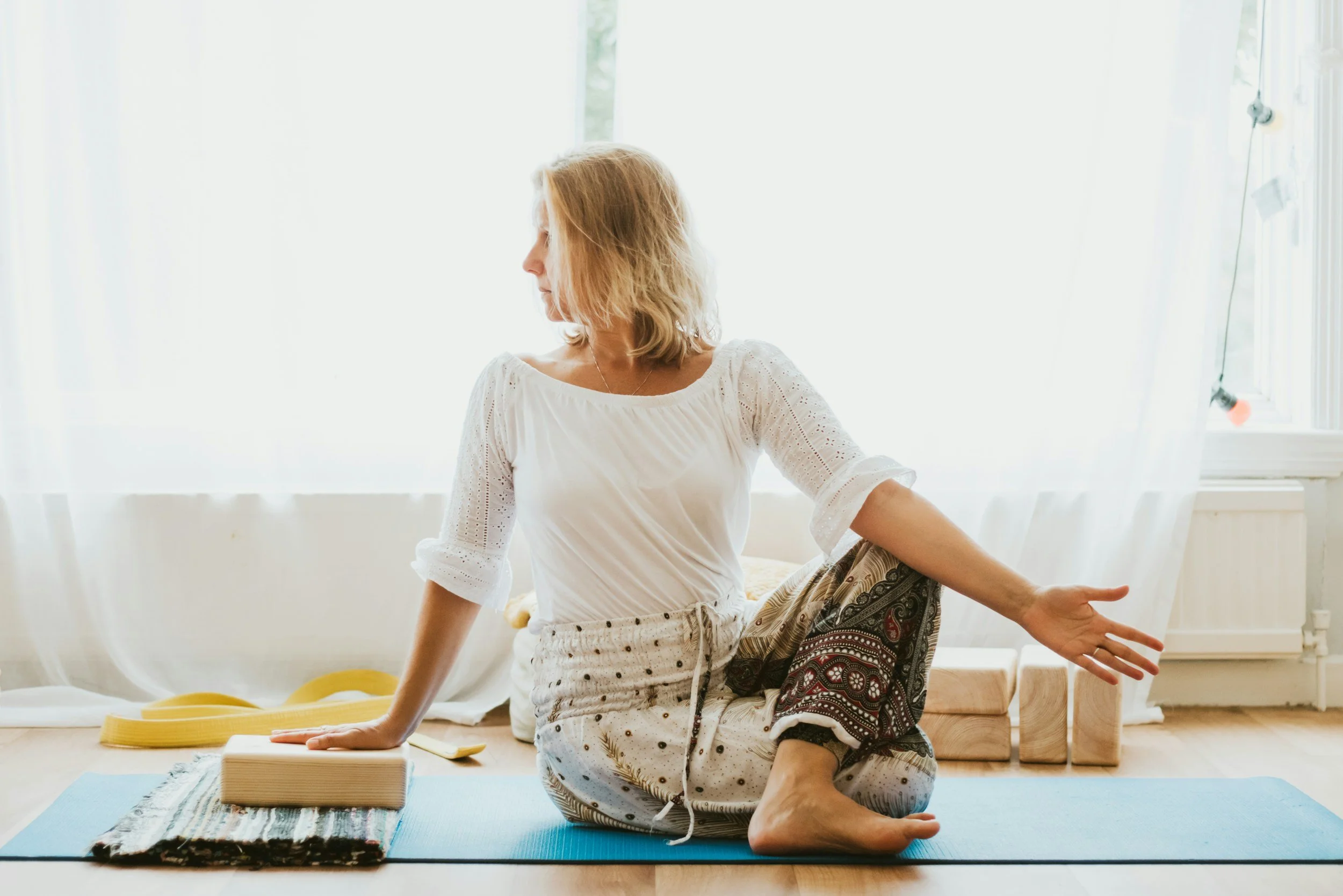
The quiet science behind the stillness — and why my whole body listened.
The first time I sat in a Yin pose for five full minutes, I almost laughed.
This is it? This is the practice?
I came to Yin the way most women do — looking for slowness. Something gentler than vinyasa. A way to stretch without sweating. I assumed it would be a softer version of what I already knew. A pause. A rest. A lovely, low-stakes thing.
I had no idea what I was actually walking into.
Because Yin Yoga, as it turns out, is not a softer version of anything. It is a completely different practice — one with its own physiology, its own science, its own intelligence. And the longer I stayed in it, the more I realized: this isn’t a “lite” yoga. This is some of the most precise, body-literate work I have ever done.
Here is what I wish someone had told me at the beginning.
It’s not your muscles that are doing the work.
In the more active practices most of us learned first, we engage muscle. We squeeze, contract, fire, hold. Yin asks for the opposite. The poses are passive. The muscles soften. And in that softening, the load travels somewhere else entirely — into the connective tissue. The fascia. The ligaments. The denser, slower, less-talked-about layer of the body that holds you together.
This was the part that genuinely changed how I thought about my body.
Fascia is the web of connective tissue that wraps every muscle, organ, and bone. It responds best to long, slow, sustained pressure — not quick stretches, not strong contractions. When you hold a Yin shape for three to five minutes, you’re not stretching a muscle. You’re hydrating fascia. You’re encouraging the slow exchange of fluid through tissue that, in most of our daily lives, never gets accessed at all.
That’s why a Yin practice can leave you feeling like something has shifted on a structural level. Because something has.
The most important part of the pose happens after you come out.
One of the things I love most about modern Yin — particularly the way teachers like Bernie Clark and Paul Grilley teach it — is the stress and rebound model.
The idea is simple. We apply a gentle, sustained stress to the tissue. Then we come out. Then we observe.
It’s the observation that does the work. The rebound — that strange, electric, slightly buzzy stillness after a long-held pose — is when the body integrates what just happened. Fluid moves. Sensation reorganizes. The nervous system catches up.
I used to think depth in a pose meant going farther. Yin taught me that depth is what happens after you come out. The most important part of the practice often happens in the silence between shapes.
This reframed everything for me — including how I move through my whole life.
Then I learned what it was doing to my nervous system.
This is the part that, honestly, I am still in awe of.
When you hold a passive shape for several minutes, with slow breath and minimal stimulation, you are doing something measurable to your nervous system. You are nudging yourself out of sympathetic activation — the do, push, perform, brace state most of us live in — and into the parasympathetic branch. More specifically, into what polyvagal theory calls the ventral vagal state. The state of safety. Of rest. Of repair. Of feeling at home in your own body.
This isn’t woo. This is vagus nerve physiology.
The long holds, the slow exhales, the absence of striving — these are direct, repeatable signals to your body that it is safe to soften. Heart rate variability shifts. Digestion turns back on. The jaw lets go of something it has been holding for a decade.
I spent years thinking I needed to do more to feel better. Yin showed me that, sometimes, the most therapeutic thing I can offer my body is the experience of not being asked to perform.
And then there are the meridians.
I was the most skeptical about this part, and now it’s one of my favorites.
Paul Grilley overlays the Yin practice with the meridian system from Chinese medicine — the energetic pathways that, in that tradition, carry Qi through the body. Each Yin pose is associated with specific meridians. Dragonfly opens the kidney and liver lines. Saddle works the stomach and spleen channels. Sphinx and seal travel up through the urinary bladder.
You don’t have to believe in any of it for it to do something.
What I notice, again and again, is that students will come out of a long-held shape and feel something shift in a part of their body that has nothing obviously to do with the pose. An old emotion in the throat. A softness behind the eyes. A warmth in the belly. The ancient framework gives us language for what the modern science is now confirming — that the body is one continuous, communicating system. Work with one part of it slowly enough, and the whole system responds.
What Yin actually is.
Yin Yoga is not a stretching class.
It is a practice of meeting your body at the level of its slowest, deepest tissues. It is a regulated, science-backed way to shift your nervous system. It is an invitation to let the rebound be as important as the pose. It is, in its quietest moments, a conversation between you and a body that has been waiting a long time to be listened to.
When I teach now, I teach with all of this underneath. The science doesn’t replace the spaciousness. It deepens it. It gives me the confidence to keep the cues simple, to trust the silence, to know that something real is happening even when nothing visible is.
If you come into a Yin class expecting a slow stretch, that is what you will receive.
But if you stay long enough — if you let the holds be long, the breath be slow, the rebound be honored — you may find that what you actually receive is something much larger.
A different relationship with your body.
A nervous system that remembers how to rest.
And the strange, quiet realization that you have been carrying things you did not know you were allowed to put down.
